Saturday, September 9, 2017

Week 7: A Lewis' Woodpecker and Migration Hits RPBO!

With the new month came an increase in birds in our nets and the arrival of several of our late season migrants. While we had pretty much full net hours at Pedder Bay throughout the week, Rocky Point was able to run nets for just 1 hour on four of the seven days this week due to military activities that required us to leave by 8:00am, unfortunately this will be a common occurrence for the rest of the month.

Species such as Lincoln's Sparrows and Swainson's Thrush  that peak in the first couple weeks of September saw their numbers rise noticeably in week 7. Other species that saw an increase in our nets this week include many of the sparrows such as Spotted Towhee, Fox Sparrow, Savannah Sparrow (Rocky Point) and Oregon Junco (mainly Pedder Bay) as well as Yellow Warbler (Pedder Bay).

Visiting volunteer Alister with a Yellow Warbler Mikolaj Szoszkiewicz
On their way out are the Flycatchers which have decreased across all species that we detect here with some, such as Olive-sided now virtually finished passing through. Swallows and MacGillivray's and Wilson's Warblers are on their way out as well and the Steller's Jay's that were so abundant last week, while still common, have reduced in numbers appreciably. We are hoping that we will still get another push of the latter a bit later on.

We have noticed an increase in Western Tanagers over the past week, in particular at Pedder Bay, with a season high 4 banded September 7th and groups of up to a half dozen or more around.

Among the new arrivals this week that will soon be filling our nets were Hermit Thrush -1 banded at Pedder Bay on September 2nd, Ruby-crowned Kinget - 1 banded at Rocky Point, also on September 2nd, and Golden-crowned Sparrow - 2 banded at Pedder Bay on September 6th.

Christian and Rick with a couple Western Tanagers! Mikolaj Szoszkiewicz
Outside of the nets we detected our first American Pipits of the season at Rocky Point with a high of 18 seen on September 4th. Also new for the season were a Sandhill Crane heard and seen first thing in the morning at Rocky Point September 5th and 1 American Wigeon among the increasing number of waterfowl at Rocky Point on the 4th. On the other end of the spectrum, while opening nets at Pedder Bay on September 2 we heard what will likely be our last Common Nighthawk of the year as these early migrants have likely left for warmer climes.

As I mentioned at the beginning of this post, the week belonged to Lincoln's Sparrow, with 75 banded between the two stations (18% of out total combined catch for the week!) and Swainson's Thrush, though the latter were by far more prevalent at Pedder Bay where the 40 were banded this week accounted for almost 15% of the weeks catch.

Both stations had a standout day this week with Pedder Bay taking the honours of most birds banded in a day with 66 new bird and 12 recaps on the 6th, the second busiest day of the season at that site. The catch included 10 each of Swainson's Thrush and Fox Sparrow, 4 Cedar Waxwing and a Black-throated Gray Warbler.
Lewis' Woodpecker Daniel Donnecke

Rocky Point's big day was more notable for what was outside of the nets as the catch for that day was a modest 24 new birds, including a season high of 5 Savannah Sparrow, and 7 recaps. In the skies there was much activity as a whopping 225 Vaux's Swifts were counted along with an estimated 200 Band-tailed Pigeon and the aforementioned Pipits. The highlight of the week though came right at the ed of the morning when a Lewis' Woodpecker was spotted atop one of the Douglas-firs near the station! These unusual woodpeckers that look like they were coloured in by a half-blind child with a set of rejected oil paints are known for their pre-migratory wanderings and once bred on southern Vancouver Island in times when the Garry Oak ecosystem was more extensive. Also atypical is there habit of feeding primarily by catching flying insects in sallies out from an expose perch, rather than by rooting out grubs in tree trunks like the most of the rest of their brethren.
Red-breasted Sapsucker Mikolaj Szoszkiewicz

Other noteworthy happenings from week 7 include up to 3 Ring-billed Gulls at Pedder Bay and the first Black Swift of the season, also detected at Pedder Bay, on the 4th. The 3rd Cassin's Vireo of the season was banded at Pedder on the 2nd and was followed the next day by a beautiful Red-breasted Sapsucker!

Finally, the week wasn't without it's humorous moments. The standout in this regard occurred early one morning at Rocky Point when, while opening nets, Blair got a shot of adrenaline as a bat flew into his face! Normally pretty adept at avoiding solid objects, this individual clearly was not expecting to encounter a moving object.

-
Rocky Point 1st 2nd 3rd 4th 5th 6th 7th Total
Banded 26 23 22 24 15 21 16 147
Species Banded 12 9 12 11 6 9 11 23
Recap 0 7 11 7 1 3 2 31
Species Recap 0 6 8 5 1 3 1 10
-
Pedder Bay 1st 2nd 3rd 4th 5th 6th 7th Total
Banded 25 31 33 30 36 66 52 273
Species Banded 14 12 12 11 10 20 14 27
Recap 5 6 10 9 11 12 9 62
Species Recap 4 4 5 9 6 8 7 13
-

Sunday, September 3, 2017

Orcas and Wolves and Pygmy Owls oh my!


Northern Pygmy-owl - Ann Scarfe

For the past few weeks everyone has been talking about these August doldrums, so you are probably wondering if those have finally come to an end? Well the answer is kind of. Both stations did see some very busy days, but those were punctuated by more classically August days. Part of these lower numbers were due to yet more shortened days at Rocky Point due to DND operations. Busy mornings on several days really give the sense that peak migrations is just around the corner! This week did not produce many new species for the year but the lone new bird was pretty incredible, a Northern Pygmy-Owl turned up in the nets at Pedder bay this Sunday!! 


Northern Pygmy-Owls are the smallest owl found in Canada, and though not uncommon are not regularly seen due to their small size and secretive behaviour. Unlike most other owl species which hunt at night, Pygmys are active during daylight hours, and are known to be voracious predators, capable of killing prey much larger then themselves, sometimes species up to 5 times their size, such as flickers and quail!!! Pygmy-Owls are most easily detected by their call, which is a slow and repetitive series of toots, and will often respond to people mimicking these calls.
Orcas near Rocky Point

Not to be completely outdone, Rocky Point was blessed with some incredible non-bird species over the week! A pod of Orcas came right into the channel multiple times during the week looking for seal snacks  and a wolf was also seen on the beaches in front of the banding station!!!
HY male Common Yellowthroat


Rocky Point started out the week with one of one the busier days of the year, catching 41 new birds and only 1 recapture, suggesting that the birds are really starting to move! Over all Rocky Point banded 231 birds, which was almost and increase of a hundred birds from last week's 158. This number would have likely been higher if it was not for partial closures on Tuesday and on Thursday which produced 32 and 13 new birds respectively. Much of Rocky’s increase in productivity was due to the 52 Pacific-slope Flycatchers which found their way into the nets!
Yellow Warbler

Wilson’s Warbler, 19, and Yellow Warblers, 18, also had a strong week. Other highlights at our Rocky Point station were 6 beautiful warblers: four Black-throated Grey Warblers and two Townsend’s Warblers. Another sign that migration is picking up is an increase in raptor activity over Rocky Point with good numbers of Turkey Vultures, Sharp-shinned Hawks and Red-tailed Hawks passing over the station each day. Hopefully, it is only a matter of time before some of the hawks start to find their way into the nets.


Young Red-tailed Hawk checking out Rocky Point


Pedder Bay also saw a good increase in birds banded, jumping from 114 last week to 213 this week! As previously mentioned the highlight was the Northern Pygmy-Owl, but it also had a nice rush of Western Tanagers, catching 7 this week, adding a splash of colour to the browns of the sparrows. Orange-crowned Warblers (19), Swainson’s Thrushes (23) and White-crowned Sparrows (46) made up the bulk of the birds banded at Pedder this week. Hopefully things continue to pick up and we get some more exciting and wonderful birds!


The Numbers:

Rocky Point 25th 26th 27th 28th 29th 30th 31st Total
Banded 41 28 24 35 32 58 13 231
Species Banded 15 12 13 11 14 16 8 28
Recap 1 7 3 5 4 6 1 27
Species Recap 1 5 3 4 3 4 1 9
Pedder Bay 25th 26th 27th 28th 29th 30th 31st Total
Banded 26 34 28 19 32 34 41 214
Species Banded 16 14 16 11 14 17 14 31
Recap 7 7 10 10 7 6 14 61
Species Recap 5 5 6 7 4 5 6 12


Monday, August 28, 2017

Week 5: Partial Eclipse of the Heart


Fox Sparrow - Avery Bartels
The August doldrums continue at the banding stations this week. Unfavorable winds forced us to close some of the more productive nets at both banding sites for several days this week. Though the remaining nets didn’t seem to do much better at catching birds,  so we can assume that the influx of fall migrants has yet to fall upon either station. However, signs that more bountiful days are just around the corner arrived in the form of a bird of particular interest to the observatory. Any Guesses?? .. A Fox Sparrow was banded at Rocky Point on August 23rd! These skulky sparrows do not breed in the Greater Victoria region, but do spend their winters here. RPBO has invested a lot of time and effort into researching where “our” Fox Sparrows breed through the use of geolocators, and has produced some fascinating discoveries (stay tuned for more information). FOSP typically show up at the banding sites around the first week of September, which coincided with some of our busiest banding days during the 2016 migration season. Fingers crossed that this chunky sparrow will usher in a new era of productivity for both sites.

Black-throated Grey Warbler
- Christian Kelly
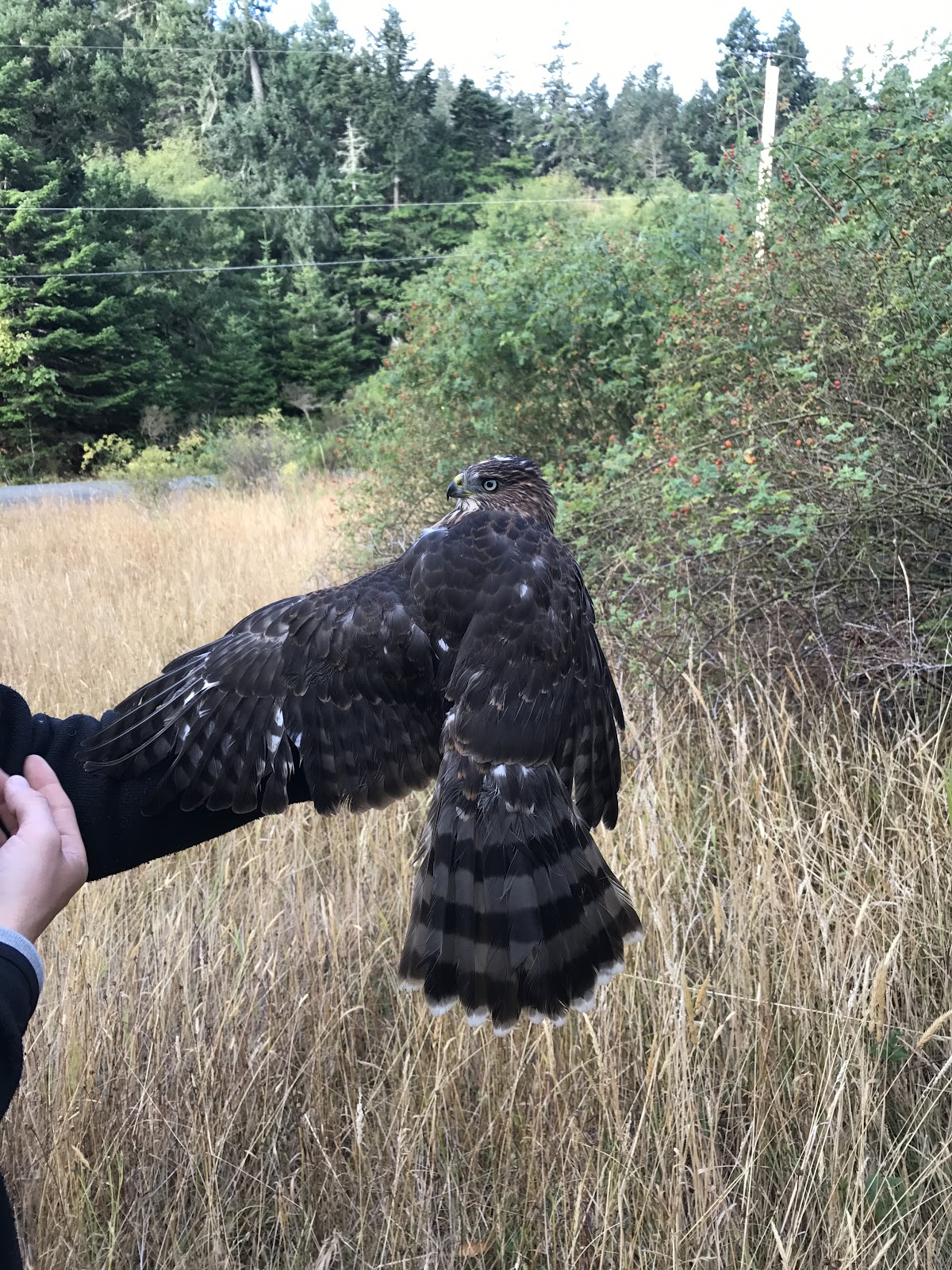
Cooper's Hawk - Christian Kelly
Pedder Bay had a particularly slow start to the week with only 39 birds banded in the first three days. Again, this was in part due to nets 7 and 8 being closed due to strong winds. Things picked up by mid week as the winds died down, and we had a couple of productive days on Monday and Tuesday with 22 and 28 birds banded respectively. Spotted Towhee (12), Oregon Junco (14), and White-crowned Sparrow (20) made up the bulk of the birds banded at Pedder this week. Peddar Bay typically catches more sparrows between our two stations. We are not entirely sure why this is, but I’m sure it doesn’t hurt that many of the nets at Pedder are nestled in the middle of a huge Blackberry thicket. In total, 115 birds were banded this week. A bit lower then last week, but not by much... Other highlights from the station included a pair of Black-throated Grey Warblers banded on the 21st, and our second Cooper’s Hawk of the season! This young COHA was found trying to escape from net 8, and is likely part of the pair that have been observed flying around the station recently.

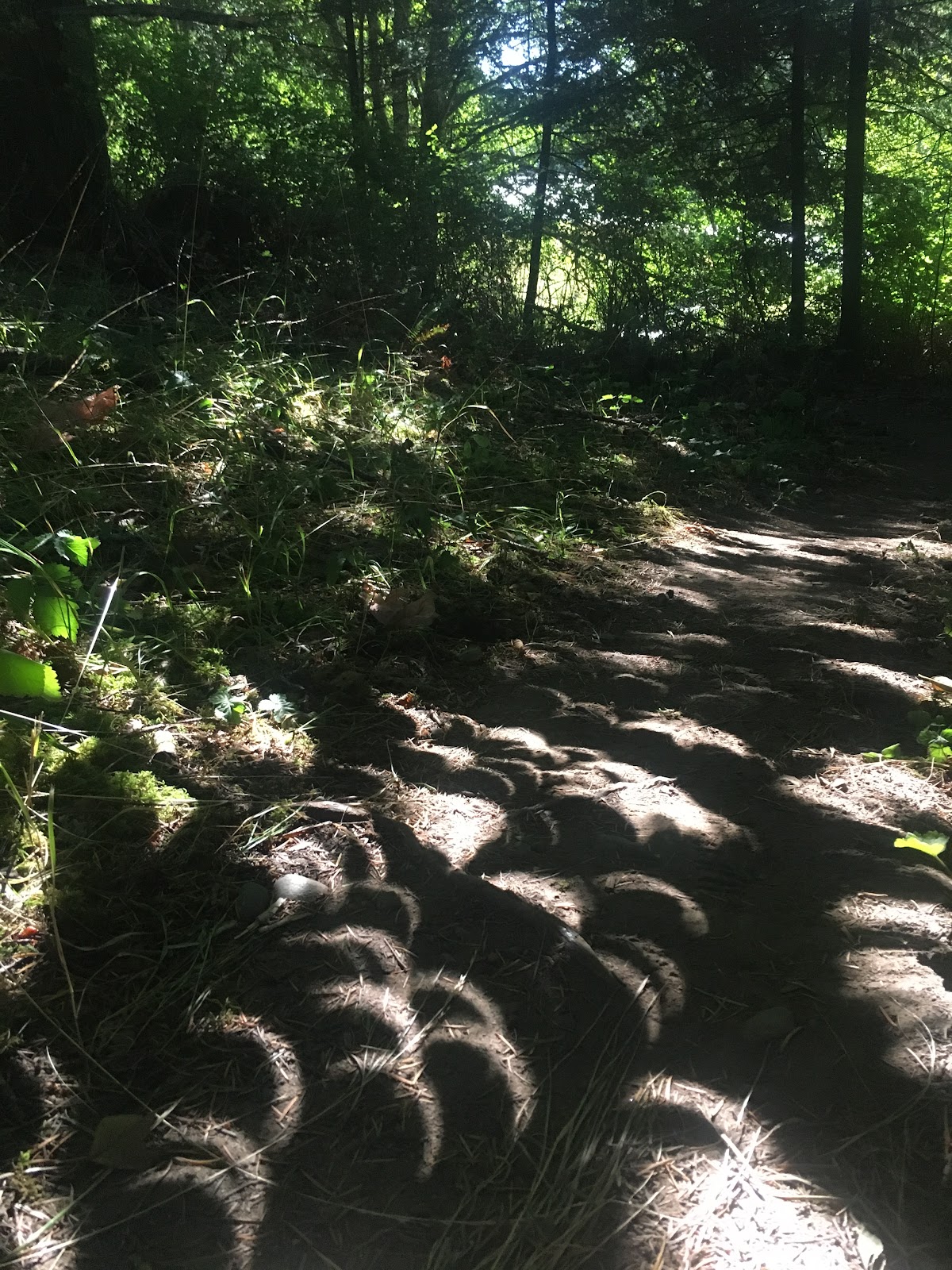
Trees acting as pinhole cameras to create mini eclipse shadow
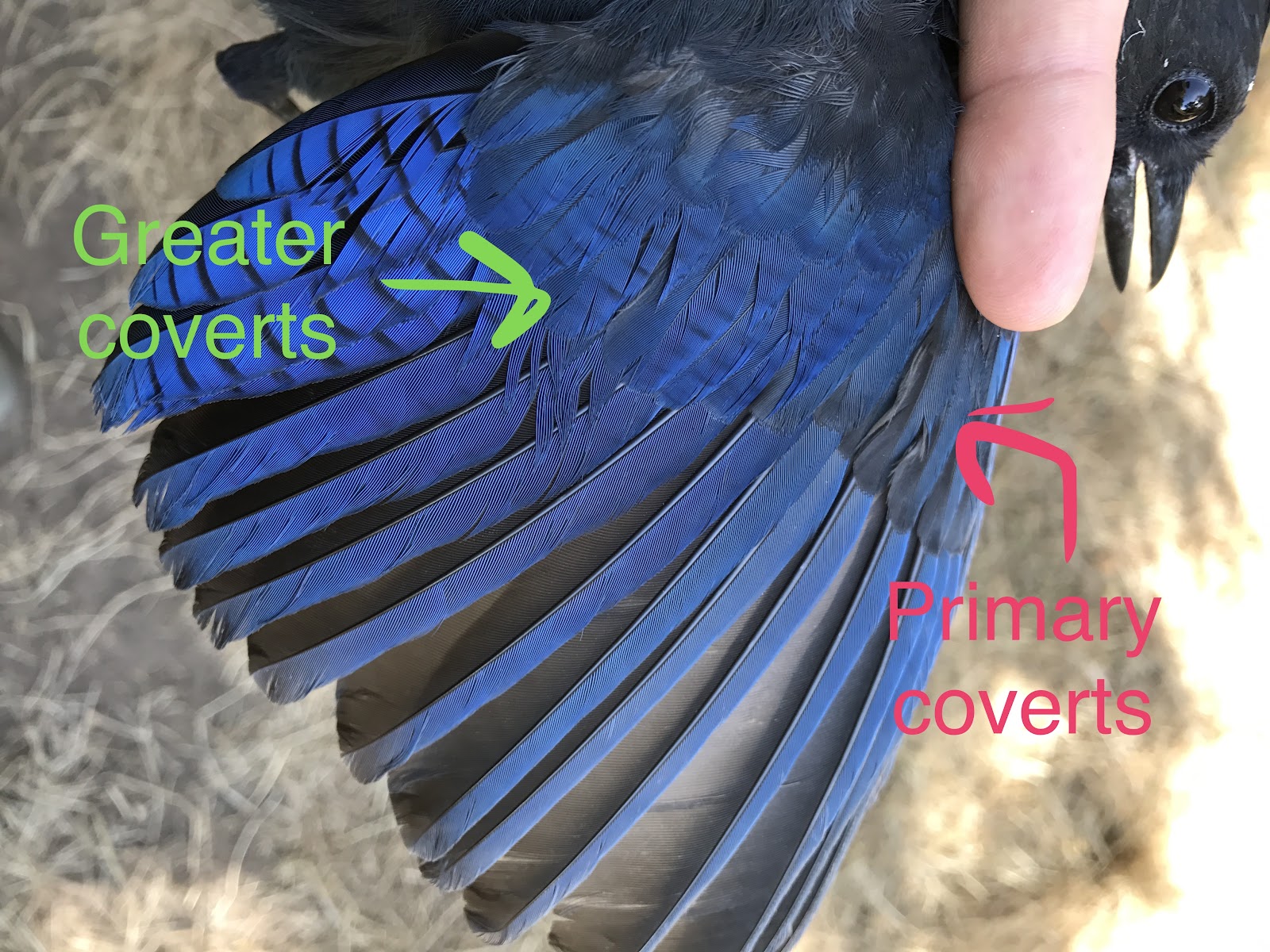
Visitors and volunteers to this station this week may not have been dazzled by bird numbers, but those who joined us on Monday the 21st were definitely kept occupied by the celestial spectacular that was the solar eclipse. There was a lot of hype for this event as it was the first time a total solar eclipse could be seen from Canada or the U.S. since 1979! Though Southern Vancouver Island was not on the path of “totality” we still had spectacular views of the “near totality” from both stations. Probably the only time during the week that anyone was truly happy to have clear skies. Interestingly enough the eclipse coincided with the arrival of large numbers of migrating Steller’s Jays (STJA). As the eclipse began, several flocks of STJA were observed flying over both stations. Even better, was right around the time the eclipse peaked, 3 STJA were caught and banded at Rocky Point! This was likely a coincidence, but it's fun to speculate if there was some sort of correlation. This was not an isolated event as a total of 7 STJA were banded at Rocky this week, and the number of Jays observed flying over continues to increase as well. All but one of the Jays banded were HY birds. The way we determine this by looking for molt limits between the Primary and Greater Coverts on the wing. If you notice in the photo, the primary coverts of this HY STJA the blue edging is a much duller when compared to the blue in the greater coverts. Also, the primary coverts lack the dark barring that you see in the greater coverts. In Adult STJA the primary coverts will resemble the greater coverts in both colour and barring. STJA numbers were way down last year so it's good to see them back in full force.
Open Wing of Steller's Jay - Christian Kelly
Overall Rocky Point had a much better week in terms of total number of birds banded. 158 new birds this week, up from 123 during week 4. Pacific-slope Flycatcher (30), Willow’s Flycatcher (18), Wilson’s Warbler (13), and White-crowned Sparrow (15) were among the top birds banded. Warbling Vireos seem to be having a bit of a bumper year with 11 banded this week for a total of 18 at Rocky (8 at Pedder). I’ll have to check my sources, but this may be our best year to date for banding this species. Our other two Vireo species (Cassin’s and Hutton’s) are also regularly seen or heard at both banding sites, so it is possible this bumper year isn’t restricted to just WAVIs. Unfortunately for us, we are not seeing the Cassin’s or Hutton’s in the net as often.

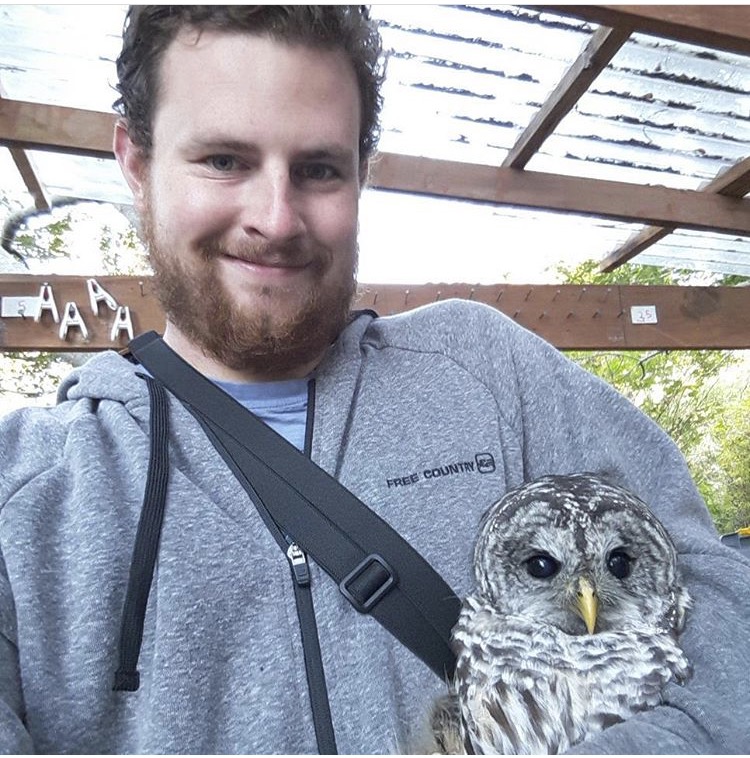
Blair with a Barred - Blair Dudeck
Rocky Point added 5 new species to the station list this week! As I mentioned earlier the Fox Sparrow and Steller’s Jay were new this week, but also Oregon Junco, Hairy Woodpecker, and Barred Owl were also added. Though we do not particularly enjoy seeing a Barred Owl in the net, as it was likely trying to predate another bird that was caught, it is always exciting when it happens. These birds are undeniably stunning, and almost seem as interested in us as we are of them.

The Numbers:

-

Rocky Point
18th
19th
20th
21st
22nd
23rd
24th
Total
Banded
19
21
27
26
25
17
23
158
Species Banded
9
10
9
16
13
9
13
24
Recap
6
9
8
5
9
6
10
53
Species Recap
3
5
5
4
5
4
7
14

-

Pedder Bay
18th
19th
20th
21st
22nd
23rd
24th
Total
Banded
13
16
10
22
28
19
7
115
Species Banded
9
11
7
13
10
11
7
26
Recap
6
6
7
11
12
0
13
55
Species Recap
5
4
6
7
5
0
5
15

-

Species
Rocky Week 5 Totals
Rocky Season Totals
Pedder Week 5 Totals
Pedder Season Totals
Virginia Rail
0
1
0
0
Cooper's Hawk
0
0
1
2
Barred Owl
1
1
0
0
Anna's Hummingbird
0
1
2
10
Rufous Hummingbird
0
28
2
46
Belted Kingfisher
0
0
0
1
Red-breasted Sapsucker
0
0
0
1
Downy Woodpecker
0
3
0
3
Hairy Woodpecker
1
1
0
2
Olive-sided Flycatcher
0
4
0
0
Willow Flycatcher
18
44
10
24
Least Flycatcher
0
1
0
0
Hammond's Flycatcher
5
10
1
3
Pacific-slope Flycatcher
30
118
7
40
Cassin's Vireo
0
0
0
2
Hutton's Vireo
0
3
0
0
Warbling Vireo
11
18
2
8
Steller's Jay
7
7
0
0
Northern Rough-winged Swallow
0
2
0
0
Chestnut-backed Chickadee
4
30
3
64
Bushtit
2
14
3
34
Red-breasted Nuthatch
0
2
0
0
Brown Creeper
0
13
1
7
Bewick's Wren
6
30
2
22
House Wren
1
13
2
31
Pacific Wren
1
2
1
2
Golden-crowned Kinglet
0
1
1
3
Swainson's Thrush
9
33
8
40
American Robin
0
5
0
11
Varied Thrush
0
1
0
0
European Starling
0
2
0
0
Cedar Waxwing
0
13
0
8
Orange-crowned Warbler
11
38
4
35
Yellow Warbler
3
23
0
3
"Audubon's" YR Warbler
0
1
0
0
Black-throated Gray Warbler
0
1
2
3
Townsend's Warbler
1
2
0
2
MacGillivray's Warbler
1
23
4
37
Common Yellowthroat
1
21
4
7
Wilson's Warbler
13
118
4
85
Western Tanager
1
3
0
1
Black-headed Grosbeak
1
3
0
3
Spotted Towhee
4
16
12
65
Chipping Sparrow
0
16
1
35
Savannah Sparrow
0
2
0
0
Fox Sparrow
1
1
0
0
Song Sparrow
3
41
2
39
White-crowned Sparrow
15
77
20
138
Dark-eyed Junco
1
1
14
42
Red-winged Blackbird
0
7
0
0
Brown-headed Cowbird
0
17
0
0
Purple Finch
0
14
2
8
House Finch
0
1
0
1
Pine Siskin
0
3
0
0
American Goldfinch
6
37
0
7


TOTALS
158
867
115
875

-